
Quick & Simple Same-Day Funding For SMBs — $25K-$15MM
We Fund What You’re Building
We are a BBB A+ rated Top 20 Fin-Tech Lender in the United States offering fast, easy, hassle-free working capital for your business — approved in hours, funded in 24 hours.No collateral. No credit impact. Just results.
Join 10,000+ businesses already growing with our reliable funding solutions. Whether you’re expanding, restocking, hiring, or stabilizing cash flow—we’re here to help. With Capital That Powers Your Growth — Apply Securely Below.
Check if your industry qualifies →
Grow Your Business The Way You Deserve and Reach Your Destination Faster
📈 98% Approval Rate | 💵 $25K–$15MM Available | 📍 Serving All 50 States
As Featured In













Apply In Minutes | Compare Options and Get Funded

No Prepayment Fees

Want to E-Sign or Talk It Through? Let’s Get Started.
Testimonials
Customer Reviews
Posted onTrustindex verifies that the original source of the review is Google. Solid team who was transparent and effective.Posted onTrustindex verifies that the original source of the review is Google. High quality team, transparent, honest. Also their financial products really provided the boost for our company.Posted onTrustindex verifies that the original source of the review is Google. Superb service in getting my business funded? Much appreciated!Posted onTrustindex verifies that the original source of the review is Google. I worked with Carlos and he was incredible. He made the whole process painless. I will definitely work with VIP Capital again in the future.Posted onTrustindex verifies that the original source of the review is Google. Great fast process, folks are a joy to work withPosted onTrustindex verifies that the original source of the review is Google. Great service, smooth fundingPosted onTrustindex verifies that the original source of the review is Google. My business was funded in a timely manner. Great group!Posted onTrustindex verifies that the original source of the review is Google. Awesome company, good work!
About Us
Trusted Business Capital from $25K to $15MM — Fast, Flexible, and Built for Growth
At VIP Capital Funding, we help small and mid-sized businesses access fast, flexible capital — from $25,000 to $15,000,000 — with no credit impact and no collateral required.
We’re a BBB A+ Rated lender trusted by over 10,000 businesses nationwide. Whether you’re expanding, restocking, hiring, or stabilizing cash flow, our team is here to get you funded — fast.
Our funding programs are designed to boost ROI, minimize paperwork, and give you the edge to grow with confidence. We advocate for your success, not just your approval.
💼 Backed by real people. Powered by real results. Built for your business.


Why Over 10,000 Businesses Trust VIP for Fast, Flexible Capital
From $25K to $15MM, we deliver same-day working capital that drives real business results.
Whether you’re expanding, restocking, hiring, or stabilizing cash flow, our clients report 300–500% ROI and zero stress thanks to:
- Funding in all 50 states
- Tax-deductible interest = bigger savings
- Small Business loans and Working Capital designed to improve cash flow over the long term
- No collateral required — unsecured, low-doc funding
- No Pay early? Get up to 35% off — no fees, no penalties

What Makes VIP Capital Different?
At VIP Capital Funding, we don’t just approve funding — we build partnerships. Our team of seasoned financial officers takes the time to understand your business, match you with the right capital product, and guide you every step of the way.
Whether you’ve been turned down by banks or just need a faster, more flexible path to growth, we’re here to deliver real support and results — not just approvals.
- When banks say NO, we say YES — 95% approval across 700+ industries
- Easy application with Instant processing and tailored consultations from Experienced Financial Officers with 5-30 years of experience
- We fund based on cash flow, not credit scores or collateral
- Use your capital for real business needs: payroll, marketing, inventory, or renovations
Our Services
Smart Capital, Backed by Real Experts
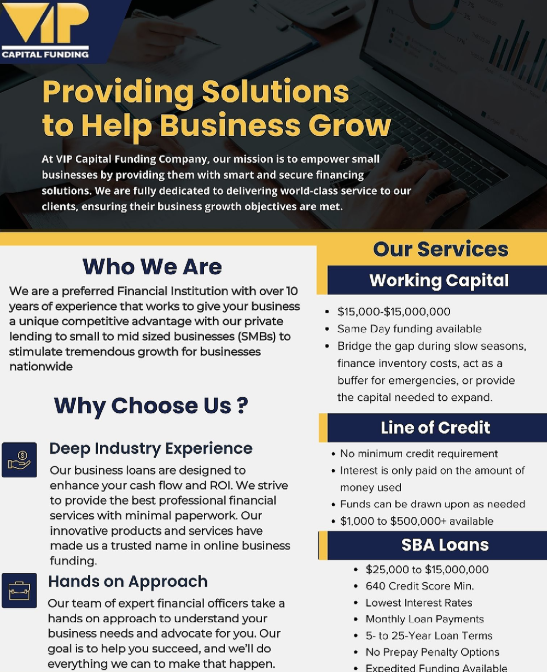
Our expert financial officers are here to help you secure the right working capital — whether you need $25K or $15 million. From SBA loans to credit lines, we match real businesses with smart funding strategies that fuel growth.
We don’t just offer capital — we guide you through the process every step of the way.






Our Specialty
Built to Serve Real Businesses. Backed by Results.
At VIP Capital Funding, we provide small and mid-sized businesses with fast, flexible working capital — and a team that works with you, not just for you. Whether you’re expanding, hiring, restocking, or recovering from a slow season, we help you access capital quickly and confidently.
From SBA loans to unsecured lines of credit, every offer is tailored to your business needs.

Loyalty Rewards that Grow with You
Businesses that return for future funding enjoy discounted rates and improved terms — because loyalty should be rewarded.

Cash Flow, Not Credit Scores
We fund based on real-time revenue — not just credit history. You can access $25K to $15MM in 1–2 days with no collateral required.

Dedicated Financial Experts
Every business is paired with a real consultant — no bots, no call centers. You’ll get tailored support from start to funded.
Our Team
Meet Our Team
Our world-class team of financial experts is dedicated to providing you with professional financial solutions with the working capital needed to take your business to new heights. We pride ourselves on delivering the best capital on the market.

Joshua Triplett
Founder | President
Joshua is the founder and CEO of VIP Capital Funding, with over 10 years of experience and $500MM+ in approved offers. Known for his integrity, strategic insight, and fast execution, he’s helped thousands of business owners access capital with no credit impact and early payoff options. His leadership ensures clients receive personalized, friction-free funding that supports long-term growth.

Carlos Hernandez
Vice President
Carlos leads client relations, funding strategy, and partnerships at VIP Capital. With 10+ years in business finance, Carlos specializes in helping small businesses unlock capital from $25K to $15MM—fast. He’s known for transparency, responsiveness, and building long-term client relationships that get results.

Randy Kranawetter
Chief Financial Officer
Randy oversees risk management, funding operations, and financial structure at VIP. With over a decade in corporate finance, he ensures each deal is built for sustainability and scalability. Randy’s approach emphasizes trust, transparency, and making complex capital strategies simple for business owners.
Get Approved within 24 Hours — No Collateral, No Credit Impact
Running a business is hard. Getting funded shouldn’t be.
At VIP Capital Funding, you can apply in minutes and get a decision in hours — with zero impact to your credit. Whether you need $25K or $15MM, our fast, flexible working capital helps you stay ahead of payroll, inventory, marketing, or any growth challenge.
Blogs
Read Our Blog Posts
Strategic Restructuring for Long-Term Business Stability in California
Businesses across California operate in one of the most competitive and fast-moving economic environments in the country. Growth opportunities are abundant, but so are the financial complexities that come with scaling operations. As companies expand, capital structures can become layered, creating pressure that limits flexibility and slows progress.
In these situations, restructuring is not a reaction—it is a strategic move. It allows businesses to realign their financial structure, stabilize operations, and position themselves for long-term growth.
Many business owners begin by reviewing small business funding solutions ↗ to maintain momentum. However, when existing obligations begin to interfere with scalability, restructuring becomes the more appropriate path.
When Strategic Restructuring Becomes Necessary
As businesses grow, they often take on multiple forms of capital at different stages. Over time, these obligations can overlap, creating inefficiencies that impact cash flow and decision-making.
Common indicators include:
- Multiple payment structures running simultaneously
- Reduced financial flexibility
- Difficulty allocating capital toward growth initiatives
- Increased complexity in managing obligations
Businesses evaluating these challenges often explore small business loans in California ↗ to compare how restructuring differs from traditional financing options.
The Purpose of Financial Realignment
Restructuring is designed to simplify—not disrupt—business operations. By consolidating or reorganizing obligations, businesses gain clarity and control over their financial structure.
With MCA debt relief program ↗ solutions, companies can:
- Streamline multiple obligations into a structured plan
- Improve visibility across financial commitments
- Reduce operational friction caused by overlapping payments
- Create a more manageable path forward
This allows businesses to transition from reactive financial management to a more strategic, controlled approach.
Supporting Stability While Maintaining Growth
One of the key advantages of restructuring is that it allows businesses to maintain operations while improving their financial position. Rather than pausing growth, companies can continue to move forward with greater control.
This means businesses can:
- Continue serving customers without interruption
- Maintain operational consistency
- Preserve revenue streams
- Focus on improving internal financial structure
Restructuring creates a stable foundation that supports both current operations and future expansion.
Aligning Financial Structure with Business Performance
A misaligned financial structure can limit a business’s ability to grow. When obligations do not match revenue patterns, it becomes difficult to manage cash flow effectively.
Restructuring addresses this by:
- Aligning payments with actual business performance
- Creating consistency in financial planning
- Reducing strain on daily operations
- Improving overall financial efficiency
This alignment allows businesses to operate with greater confidence and predictability.
Avoiding Long-Term Financial Friction
Without restructuring, businesses may continue to experience financial friction that slows progress. This can include ongoing cash flow pressure, limited access to new capital, and reduced operational flexibility.
By addressing these issues proactively, businesses can:
- Simplify their financial landscape
- Improve decision-making
- Reduce unnecessary complexity
- Strengthen their overall financial position
This approach ensures that growth is supported rather than restricted by existing obligations.
Building a Stronger Financial Foundation
Restructuring is not just about solving immediate challenges—it is about building a stronger foundation for the future. Businesses that take a structured approach to financial realignment are better positioned to scale sustainably.
This leads to:
- Improved financial discipline
- Greater control over capital allocation
- Enhanced operational efficiency
- Increased long-term stability
Business owners often review verified client experiences ↗ to understand how restructuring has supported other companies in achieving these outcomes.
Transitioning from Stabilization to Growth
Once restructuring is in place, businesses can shift their focus back to growth. With a clearer financial structure, they are able to pursue expansion opportunities with greater confidence.
This transition includes:
- Reinvesting in operations
- Exploring new markets
- Improving efficiency across the business
- Strengthening overall strategy
Restructuring becomes a turning point that enables businesses to move forward more effectively.
Market Recognition of Structured Capital Strategies
The importance of aligning financial structure with business growth continues to be recognized across major financial publications.
(https://underconstructionpage.com/options-for-immediate-business-financial-support/)
These insights reinforce the role of strategic restructuring as a critical component of long-term business success.
Moving Forward with a Clear Strategy
Businesses that approach restructuring strategically are better equipped to manage their obligations and position themselves for sustained growth. By simplifying financial commitments and improving alignment, they create the conditions needed for long-term success.
A controlled restructuring strategy supports operational continuity while strengthening financial stability, allowing businesses to focus on expansion and opportunity.
Companies ready to take the next step can begin with a confidential funding review ↗ to evaluate their options and determine the best path forward.
estoring Financial Clarity in Complex Business Environments
As businesses grow, financial structures often become more complex. Multiple funding sources, different repayment schedules, and varying terms can make it difficult to maintain a clear financial picture. Over time, this lack of clarity can impact decision-making and limit a company’s ability to plan effectively.
Restructuring helps restore that clarity by simplifying obligations into a more organized framework. With a clearer financial structure, business owners can:
- Understand their true financial position
- Make more informed strategic decisions
- Allocate resources more efficiently
- Plan for both short-term operations and long-term growth
In high-cost, high-competition markets like California, this level of clarity is essential for maintaining momentum and staying competitive.
Reducing Operational Pressure Through Structured Realignment
When financial obligations are fragmented, they can create constant operational pressure. Business owners may find themselves focusing more on managing payments than on running and growing their business.
A structured approach to restructuring helps reduce this pressure by:
- Creating a more manageable repayment structure
- Eliminating overlapping obligations
- Allowing for better alignment between revenue and expenses
- Providing breathing room for operational focus
This shift allows leadership to redirect attention toward growth initiatives rather than financial strain.
Strengthening Long-Term Financial Discipline
Restructuring also presents an opportunity to strengthen financial discipline. By evaluating how obligations accumulated, businesses can implement better systems and strategies moving forward.
This often includes:
- More strategic capital deployment
- Improved cash flow tracking
- Better alignment between revenue and financial commitments
- Stronger internal financial controls
These improvements help ensure that future growth is supported by a more stable and disciplined financial foundation.
Preparing for Future Growth Opportunities
Once financial structure is realigned, businesses are in a stronger position to pursue new opportunities. Instead of being constrained by existing obligations, they can focus on expansion with greater confidence.
This preparation allows businesses to:
- Reinvest in operations and infrastructure
- Expand into new markets
- Increase operational efficiency
- Pursue higher-value opportunities
By taking a proactive approach to restructuring, companies position themselves not just for recovery—but for sustained growth.
Creating a More Resilient Business Model
Ultimately, restructuring contributes to building a more resilient business. Companies that simplify and align their financial structures are better equipped to handle market changes, economic shifts, and future challenges.
A resilient business model includes:
- Predictable financial obligations
- Strong cash flow management
- Flexible operational capacity
- A clear path for future expansion
This resilience is what allows businesses to move forward with confidence, even in competitive and rapidly changing environments.
Managing Existing Obligations While Growing a Business in New York
Running a business in New York comes with both opportunity and complexity. As companies expand, they often rely on different forms of capital to support growth. Over time, these financial obligations can overlap, creating pressure on cash flow and limiting flexibility.
In these situations, consolidation becomes a strategic tool—not a reactive measure. It allows businesses to reorganize existing obligations into a more structured and manageable format, supporting both stability and continued growth.
Many business owners begin by exploring small business loan options ↗ to understand how structured capital compares to their current financial setup.
Why Debt Consolidation Becomes Relevant
Debt consolidation becomes relevant when multiple obligations begin to impact daily operations. This is not uncommon for businesses that have scaled quickly or used different funding solutions at various stages.
Common indicators include:
- Managing multiple daily or weekly payments
- Reduced flexibility in cash flow
- Increased difficulty planning expenses
- Limited ability to reinvest in growth
Businesses evaluating these conditions often look at small business loans in New York ↗ to better understand how consolidation compares to traditional financing options.
The Purpose of Consolidation in Business Strategy
The goal of consolidation is to simplify financial structure while maintaining operational continuity. Rather than managing several obligations separately, businesses transition into a more organized repayment structure.
With MCA debt consolidation ↗, businesses can:
- Combine multiple obligations into a single structured plan
- Improve visibility over financial commitments
- Reduce administrative complexity
- Create a more predictable payment structure
This approach allows business owners to focus on operations and growth rather than managing fragmented financial obligations.
Supporting Cash Flow Alignment
One of the most important benefits of consolidation is improved cash flow alignment. When payments are structured more effectively, businesses can better match their obligations with revenue patterns.
This creates:
- Greater consistency in financial planning
- Reduced strain on daily operations
- Improved ability to manage seasonal fluctuations
- More flexibility for reinvestment
Properly aligned financial structures allow businesses to operate with greater confidence and control.
Maintaining Growth While Restructuring
A common misconception is that consolidation slows down growth. In reality, when implemented correctly, it supports continued expansion by reducing financial friction.
Businesses can continue to:
- Serve customers without disruption
- Maintain operational consistency
- Explore new opportunities
- Invest in strategic initiatives
Consolidation is not about stepping back—it is about creating a stronger foundation to move forward.
Avoiding Financial Fragmentation
As businesses grow, it is easy for financial structures to become fragmented. Different funding solutions, timelines, and repayment terms can create complexity that is difficult to manage.
Consolidation addresses this by:
- Streamlining obligations into a unified structure
- Reducing overlapping payment schedules
- Improving clarity in financial management
- Supporting long-term planning
By simplifying the financial landscape, businesses gain better control over their operations.
Strategic Timing for Consolidation
Timing plays a critical role in how effective consolidation will be. Acting early allows businesses to preserve flexibility and avoid unnecessary financial pressure.
Indicators that consolidation may be appropriate include:
- Increasing difficulty managing multiple payments
- Declining efficiency in cash flow management
- Reduced access to new capital
- Limited ability to scale operations
Recognizing these signals early allows for a more controlled and strategic transition.
Strengthening Financial Stability
Consolidation is ultimately about strengthening financial stability. When obligations are properly structured, businesses can operate more efficiently and plan for the future with greater clarity.
This leads to:
- Improved cash flow management
- Reduced financial stress
- Greater operational flexibility
- Enhanced long-term sustainability
Business owners often review verified client experiences ↗ to understand how consolidation has supported other companies in similar situations.
Transitioning Toward Long-Term Growth
Once consolidation is in place, businesses are better positioned to transition back into growth mode. With a clearer financial structure, they can focus on expansion strategies without being constrained by fragmented obligations.
This includes:
- Reinvesting in operations
- Exploring new market opportunities
- Improving overall efficiency
- Strengthening financial discipline
Consolidation becomes a stepping stone toward a more stable and scalable business model.
A Controlled Approach to Financial Realignment
The purpose of consolidation is not to eliminate responsibility, but to create alignment. When financial obligations match the realities of business performance, companies can operate more effectively and plan with confidence.
This controlled approach ensures that:
- Financial decisions are strategic
- Growth remains achievable
- Stability is preserved
It reflects a broader principle: aligning capital structure with business momentum.
Moving Forward with Confidence
Businesses that take a structured approach to consolidation are better equipped to manage their obligations and move forward with clarity. By simplifying financial commitments, they create space for growth and long-term success.
A well-executed consolidation strategy supports operational continuity while improving financial alignment, allowing businesses to focus on expansion and opportunity.
Companies ready to evaluate their options can begin with a confidential funding review ↗ to determine the most appropriate path forward.
Improving Financial Visibility Through Consolidation
One of the most immediate benefits of debt consolidation is improved financial visibility. When multiple obligations are combined into a single structured plan, business owners gain a clearer understanding of their overall financial position.
Instead of tracking multiple payment schedules, terms, and balances, consolidation allows businesses to:
- Monitor a single, streamlined obligation
- Improve accuracy in financial forecasting
- Reduce administrative complexity
- Make more informed strategic decisions
This clarity is especially valuable in fast-paced markets like New York, where businesses must make quick, informed decisions to remain competitive.
Creating a More Predictable Financial Structure
Predictability is essential for sustainable growth. When financial obligations are fragmented, it becomes difficult to plan ahead or allocate resources effectively.
Consolidation introduces a more predictable structure by:
- Establishing consistent payment expectations
- Aligning obligations with revenue cycles
- Reducing unexpected financial strain
- Supporting long-term planning
With a more predictable financial foundation, businesses can focus on executing growth strategies rather than constantly adjusting to shifting obligations.
Reinforcing Stability Before Scaling Further
Before pursuing additional growth, it is often necessary to reinforce financial stability. Consolidation provides an opportunity to reset and strengthen the business’s financial structure.
This allows companies to:
- Stabilize operations
- Improve internal financial discipline
- Prepare for future capital opportunities
- Build a stronger foundation for expansion
By taking a controlled approach to consolidation, businesses position themselves to grow more effectively in the next phase of their development.
When Business Debt Restructuring Becomes a Strategic Decision
As businesses grow, financial complexity increases. What begins as manageable capital can evolve into overlapping obligations that impact cash flow, limit flexibility, and slow down expansion. In these situations, restructuring is not a sign of failure—it is a strategic decision to regain control and realign financial structure with business performance.
Many business owners first explore small business funding options ↗ to maintain momentum. However, when existing obligations begin to interfere with growth, restructuring solutions become a more appropriate path forward.
Understanding When Restructuring Is Necessary
Debt restructuring becomes relevant when businesses experience:
- Multiple overlapping payment obligations
- Reduced cash flow flexibility
- Difficulty maintaining consistent operational performance
- Limited ability to take on new opportunities
These challenges are not uncommon, especially for businesses that have used multiple forms of capital during different growth stages.
Companies evaluating options often review small business loans in Pennsylvania ↗ to understand how structured capital compares to existing obligations.
The Role of Debt Relief in Business Stability
Debt relief solutions are designed to stabilize—not disrupt—business operations. The goal is to create a more manageable financial structure that allows businesses to continue operating while improving long-term sustainability.
With MCA debt relief program ↗ solutions, businesses can:
- Consolidate multiple obligations into a structured plan
- Reduce payment pressure on daily operations
- Improve cash flow management
- Create a clearer path toward financial stability
This approach allows businesses to shift from reactive decision-making to strategic planning.
Maintaining Operations While Restructuring
One of the biggest concerns business owners have is whether restructuring will interfere with operations. In most cases, properly structured relief solutions are designed to support ongoing business activity rather than restrict it.
This means businesses can:
- Continue serving customers
- Maintain payroll and operational expenses
- Preserve existing revenue streams
- Focus on rebuilding financial stability
Restructuring is not about stopping operations—it is about creating the conditions for sustainable growth.
Avoiding the Cycle of Over-Leverage
Without intervention, businesses can fall into a cycle where new capital is used to manage existing obligations rather than support growth. This cycle can limit long-term potential and create ongoing financial pressure.
Debt restructuring helps break this pattern by:
- Simplifying financial obligations
- Aligning payments with business performance
- Reducing reliance on short-term solutions
- Restoring control over financial strategy
By addressing the root of the issue, businesses can move forward with a more stable foundation.
Strategic Timing for Debt Relief
Timing is critical when considering restructuring. Acting too late can increase financial strain, while acting early can preserve more flexibility and options.
Indicators that restructuring may be appropriate include:
- Increasing difficulty managing payments
- Declining cash flow stability
- Limited access to new capital
- Reduced operational flexibility
Recognizing these signals early allows businesses to take a proactive approach rather than reacting under pressure.
Positioning for Recovery and Growth
Debt relief is not the end of growth—it is a transition point. Businesses that restructure effectively often emerge with stronger financial systems and improved operational discipline.
After restructuring, companies are better positioned to:
- Rebuild cash flow stability
- Improve financial management practices
- Pursue growth opportunities more strategically
- Access capital under more favorable conditions
Business owners often review verified client experiences ↗ to understand how restructuring has supported similar companies through this transition.
A Controlled Approach to Financial Realignment
The goal of restructuring is not to eliminate responsibility—it is to create a structure that aligns with the reality of business operations. When obligations are properly aligned, businesses can operate more efficiently and plan for the future with greater confidence.
A controlled approach ensures that:
- Financial decisions are strategic rather than reactive
- Growth remains possible during and after restructuring
- Business stability is preserved
When Restructuring Becomes the Right Move
Restructuring becomes the right decision when it allows a business to move forward without being constrained by past financial commitments. It is a strategic tool designed to restore balance and enable future growth.
When implemented correctly, it creates:
- Improved cash flow
- Reduced financial pressure
- Greater operational flexibility
- A clearer path toward long-term success
This aligns with the broader principle of maintaining business momentum while adapting to changing financial conditions.
Moving Forward with a Clear Strategy
Businesses that take a structured approach to debt relief are better positioned to regain control and move forward confidently. By addressing financial challenges proactively, they create opportunities for stability and future growth.
A well-executed restructuring strategy supports operational continuity while improving financial alignment, allowing businesses to focus on what matters most—running and growing the business.
Companies ready to evaluate their options can begin with a confidential funding review ↗ to determine the most appropriate path forward.
Rebuilding Financial Control After Restructuring
One of the most important outcomes of a successful restructuring is the ability to regain financial control. When obligations are simplified and aligned with business performance, decision-making becomes clearer and more strategic.
Businesses that complete a restructuring phase often find they can:
- Plan expenses with greater accuracy
- Allocate capital more effectively across operations
- Reduce financial stress on daily business activities
- Focus on long-term growth instead of short-term survival
This shift allows business owners to move from reactive financial management to proactive planning. Instead of constantly adjusting to payment pressure, they can begin making decisions based on opportunity and growth potential.
Strengthening Operational Discipline Moving Forward
Restructuring also creates an opportunity to strengthen internal financial discipline. Businesses that take time to evaluate how obligations accumulated are better positioned to avoid similar challenges in the future.
This often leads to improvements such as:
- More careful capital deployment decisions
- Better tracking of cash flow and expenses
- Stronger alignment between revenue and financial commitments
- More strategic use of funding for growth initiatives
These improvements are not just short-term fixes—they become part of a stronger operational foundation.
Transitioning from Stabilization to Growth
After restructuring, the goal is not just stability—it is controlled growth. Businesses that successfully navigate this phase are able to transition from managing obligations to pursuing new opportunities.
This transition typically includes:
- Rebuilding financial confidence
- Identifying areas for expansion
- Preparing for future capital needs
- Strengthening overall business strategy
By approaching restructuring as a strategic reset rather than a setback, businesses can position themselves for a more stable and scalable future.